Folk

Evan Decker, American, Kentucky, 1912-1981
Home on the Range: The Long Environment, about 1973-1974, mixed media
Partial gift of Larry Hackley, Arthur Jones, James Pierce, Richard Smith, Ellworth Taylor, Sidney Webb with partial funds provided by Dr. R. Lawrence Dunworth
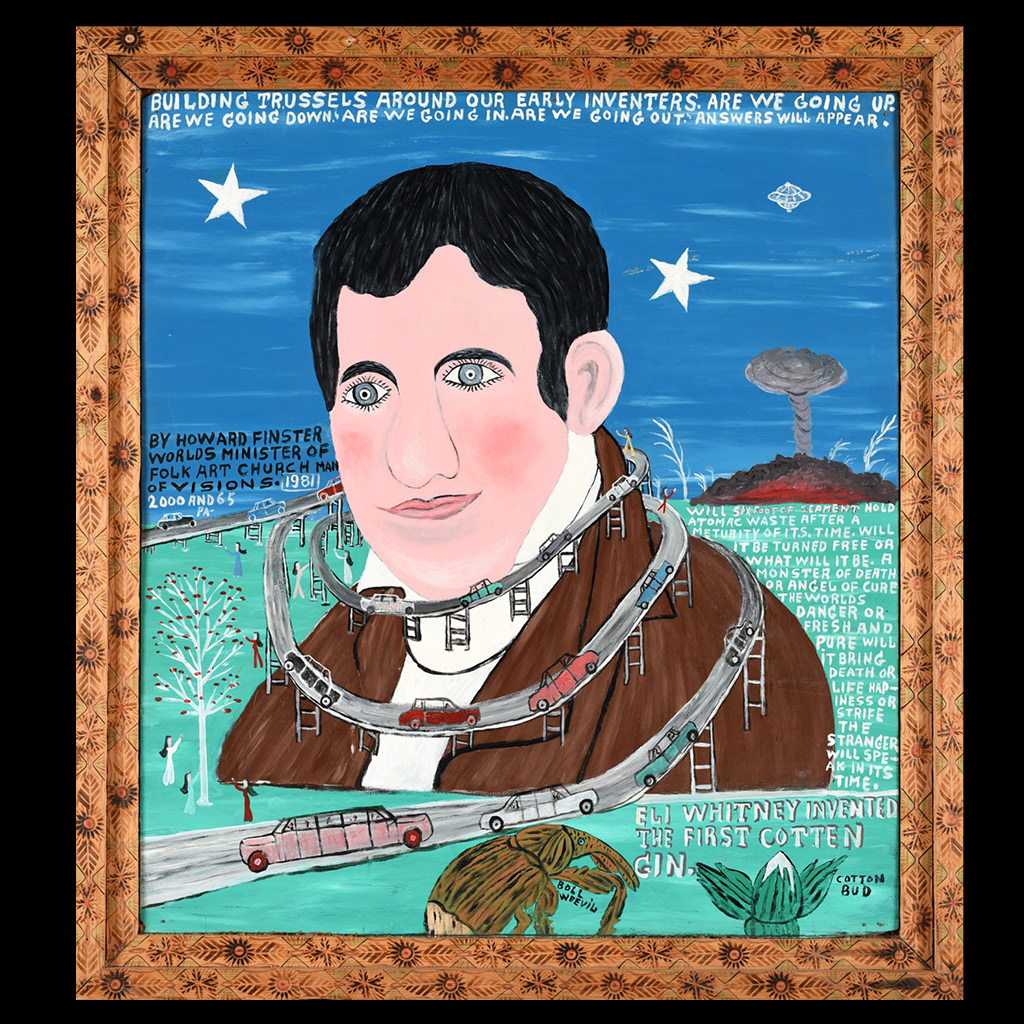
The folk art collection includes more than 200 outstanding examples of paintings, drawings, sculpture, textiles and “eccentric” furniture by nationally known, self-taught artists including Edgar Tolson, Shields Landon Jones, Garland and Minnie Adkins, Dilmus Hall, Evan Decker, Noah and Charlie Kinney, Linvel Barker, Jimmy Lee Sudduth, “The Baltimore Glass Man”, The Reverend Howard Finster and others.
The collection also has excellent 19th century folk art examples of paintings, sculpture and textiles, including works by Charles Sullivan, Susannah F. Nicholson, Asa Ames, Eliza Isabella Means Seaton, and many unknown artists.
The formation of this collection began in the early 1980s. Many of the artists represented in the collection are from Kentucky and West Virginia, and other Appalachian states. A few artists, especially Evan Decker, S.L. Jones, Minnie Adkins, and Charley and Noah Kinney, are represented by an extensive numbers of objects.
Evan Decker (1912-1981) a farmer and carpenter in Wayne County, Kentucky, created nostalgic environments that look back to the “horse and buggy” days inspired by fond memories of his boyhood home, and family. These “homes on the range” are enclosed with fences, decorated with rocks, and artificial flowers, and populated with stylized carved and painted wooden figures - working, riding horses, and sitting on the porch in their rocking chairs - idyllic scenes of a bygone era. Decker’s early unpainted pieces from the

Charley Kinney, American, Kentucky, 1906-1991
Tarnado (sic) (Tornado), 1985, Pencil and paint on paper.
Gift of Mr. Larry Hackley
1940s foreshadow his more elaborate, painted work of the 1970s. Often, the artist combined found wood, such as tree limbs, and roots with delicately carved birds, squirrels, and other woodland creatures. The Great Horse became a performance piece when taken to local festivals. Evan Decker would sit atop the horse, play his harmonica, and sing his favorite song, “Home on the Range.”

Noah Kinney, American, Kentucky, 1912-1991
Ann Mary from the Kinney Band, early 1980s, wood, cloth, objects
Funds provided by Mrs. Donna S. Hall
Brothers Charley (1906-1991) and Noah (1912-1991) Kinney began creating art after both “retired” from farming. Animals were favorite subjects. Charley Kinney had an extremely active imagination, and vivid memories of past events. Dramatic portrayals of natural and supernatural forces are the subject of his narrative, highly emotional, colorful paintings. Correct scale and proportion were of little interest. Necessary frugality defines the brothers’ work, which stems from their hardscrabble existence. Old window shades became paintings, and creek clay was formed into animal and human-shaped sculptures. Found materials were recycled into art.
Shields Landon (“S. L.”) Jones (1901-1997) began carving wooden busts and figures of family, old friends, and co-workers, soon after retiring from 46 years with the Chesapeake and Ohio Railroad. After his wife of 45 years passed away, Jones found himself facing a lonely retirement. To combat depression, and keep himself active, Jones rediscovered carving and fiddle playing which he had learned as a young boy. Jones’ sculptures have a solidity of form with wide faces, and narrow eyes, yet they were more than works of art; they were companions. In his later years, after a stroke left him unable to wield sculptor’s tools, he turned to drawing the same type of figures he had sculpted.

Minnie Adkins, American, b. 1934
Black Bear, 1987, wood
Overall: 12 1/2 x 29 x 5in. (31.8 x 73.7 x 12.7cm), Place of Origin: Kentucky, United States
Gift of Robert B. Egelston
Self-taught artist Minnie Adkins (b. 1934) grew up in the mountains of northeast Kentucky, the daughter of a tobacco farmer. She did some whittling as a child, making small roosters and horses. When her husband Garland was laid off, she took up her knife again and began selling small roosters at flea markets. She noticed the wooden carvings on display in the window of a local art gallery, which inspired her to create larger figures. She has been carving ever since, transforming wood into the lively animals of the Kentucky hills, or creating tableaux of biblical subjects.

Shields Landon (S. L.) Jones, American, 1901-1997
Uncle Adam's Supper, 1983, Carved and painted wood.
Gift of Robert B. Egelston
The animals most frequently found in Minnie Adkins’ menagerie are roosters, foxes, opossums, and bears. She collaborated with her husband on larger pieces until his death in 1997, Garland doing the initial shaping, and Minnie finishing and painting. In 1999, she married Herman Peters, a retired pipe fitter and welder, and the two have now begun to translate Minnie’s designs into metal. Her work has been exhibited and acquired by public and private collections throughout the nation.
Asa Ames’s (1823-1851) story is a fascinating, and ultimately tragic, one of an early folk artist. He was born in New York State, probably near Buffalo. Though his early career cannot be traced with certainty, by 1847 Ames was residing in Albany with a family, for whom he carved busts of three children. This was to be the pattern for the rest of his short life. Apparently suffering from tuberculosis, he spent extended periods of time living with various family members and friends, carving busts and full-length sculptures of the younger members of the household, perhaps in exchange for medical care. His work, of gessoed and painted wood, was characterized by a direct frontality with great attention to detail and dress. Sadly, he was finally overcome by his illness, and he died at age 27.
The Huntington Museum’s Bust of a Young Man (ca. 1847), though unsigned and undated, can be attributed to Ames on stylistic and other grounds. An interesting feature is a circular hole into which some type of ornament was originally placed. It may have been a medallion recording an academic, athletic, or other achievement. Whatever it was, the prominence of its placement indicates great importance to its owner.